

Last Updated: November 16, 2026
Quick Summary
Collectors seek volcano agate skulls because each one is hand-carved from a single nodule of banded volcanic agate, so no two carvings share the same pattern. The skull form exposes cross-sections of the stone's deposition record, and the carving itself becomes a variable that shapes the piece.
- Volcano agate forms in volcanic rock cavities where silica-rich water deposits layers over long periods.
- Genuine agate banding shifts as you rotate the piece, while printed or dyed patterns stay flat.
- Agate ranks around 6.5 to 7 on the Mohs hardness scale, harder than glass.
- Not all genuine volcano agate fluoresces, so a dark UV result proves nothing negative.
- At Oak & Quartz, volcano agate skulls start at $138 and blue plume agate skull carvings start at $28.
Table of Contents
- What Makes Volcano Agate Skulls Worth Collecting
- Natural Pattern and Color Variation in Every Skull
- How to Identify Real Agate in a Carved Skull
- UV Reactive Volcano Agate and What Fluorescence Really Tells You
- Skull Symbolism and the Display Appeal of Carved Stone
- What Volcano Agate Skulls Cost and What Drives the Price
- How to Clean and Store Agate Skulls Without Damaging Them
- Choosing Your Volcano Agate Skull from Oak & Quartz
- Frequently Asked Questions
What Makes Volcano Agate Skulls Worth Collecting
Volcano agate skulls are hand-carved pieces of banded volcanic agate, shaped into skull forms and polished to reveal the stone's natural layers. Collectors seek them because no two carvings share the same pattern, and each one is cut from a single nodule of stone.
The stone explains most of the appeal. Volcano agate forms in volcanic rock cavities, where silica-rich water deposits layer after layer over long periods, producing visible banding, color shifts, and occasional translucency. Carving a skull from that material is a decision about where to cut.
Most pages ranking for this query are product listings or short community posts that show a skull, mention UV glow and price, and stop there. They rarely answer why you would build a collection around this object. The reasons fall into four practical categories, none requiring a metaphysical claim.
Aesthetic reasons: pattern density per square inch
A sphere or tower gives you one continuous surface. A skull gives you a dome, two eye sockets, a nasal cavity, a jawline, and a cranium curve, each a different cut through the same nodule. One carving can show horizontal banding on the forehead, swirling layers across the cheek, and tight concentric rings inside an eye socket. The trade-off: a carver who misjudges the cut can bury the best banding inside the jaw.
Geological reasons: a readable record of formation
Agate banding is a deposition record. Each layer marks a change in silica concentration, trace-mineral chemistry, or the shape of the cavity the water filled. A carved skull exposes cross-sections of that record that a raw nodule hides. On a polished skull you can often trace a band from the crown down the side and watch it compress, fold, or terminate. For collectors interested in how the stone formed, the carving is a form of sample preparation, it turns an enclosed nodule into a viewable section. The Mindat mineral database entry on agate is a useful reference for understanding how agate varieties are classified by geologists.
Artistic reasons: the carver as a variable
Condition matters too; a chipped eye socket or dulled polish is a permanent record of handling.
Collecting reasons: a finite, catalogable set
Because each skull is cut from a single nodule, no two pieces are alike.
Below, we break down how to spot genuine agate, what drives price, how UV response actually works, and how to care for a piece so it lasts.
Natural Pattern and Color Variation in Every Skull
Every volcano agate skull is one-of-a-kind because the banding, color, and translucency are fixed by the stone before carving begins.
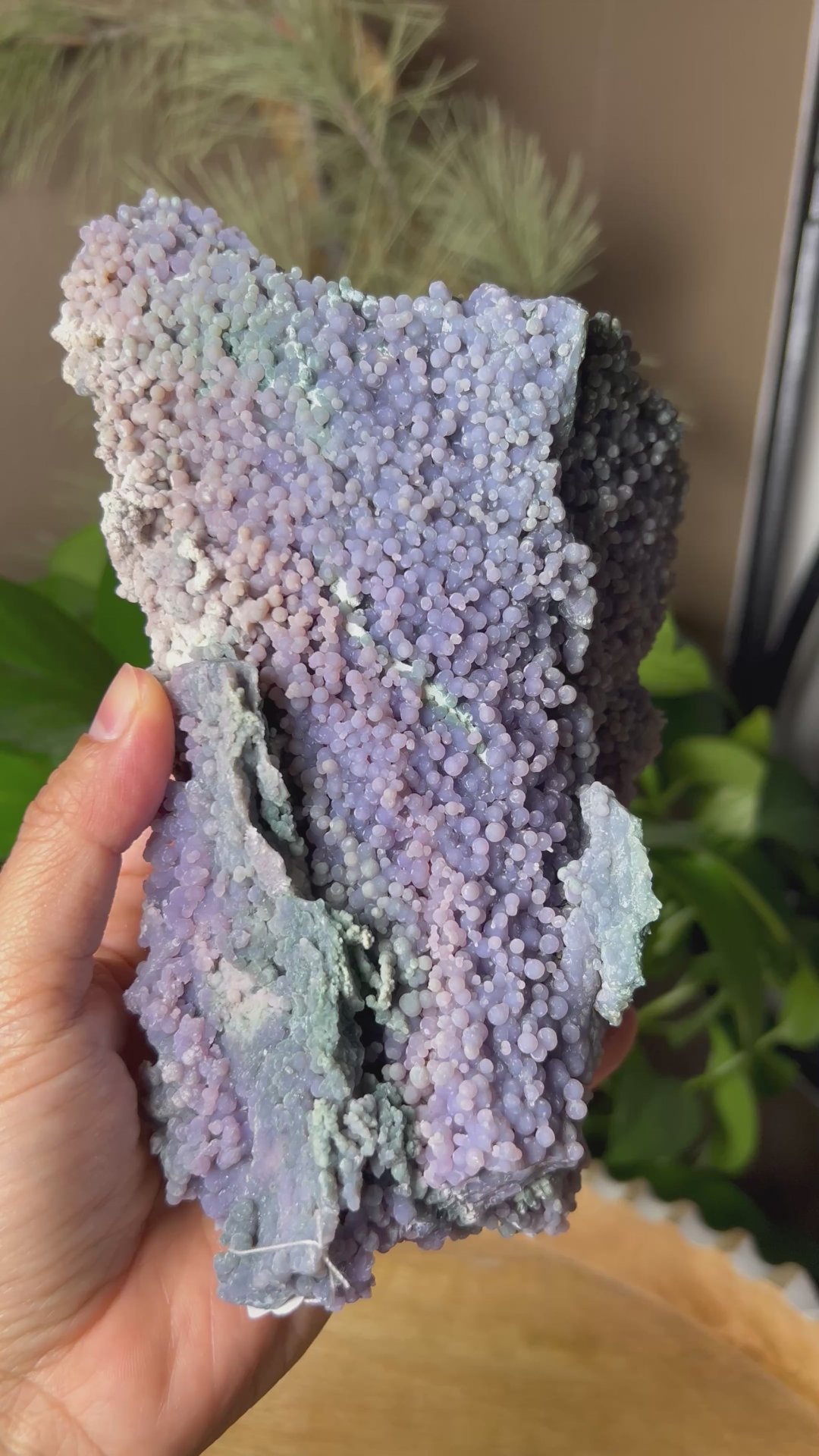
The variation shows up in a few ways:
- Banding direction: layers can run horizontally, swirl, or form tight concentric rings
- Color palette: deep reds, rust browns, smoky greys, and occasional blue-green tones
- Translucency: some sections glow when backlit, others stay opaque
- Surface texture: polished areas contrast with natural vugs and drusy pockets
How to Identify Real Agate in a Carved Skull
Real agate shows natural banding, slight translucency at the edges, and a hardness that resists scratching. But a checklist is only useful if you know what each check tests and where it can mislead you.
What the banding test is really checking
Agate banding is a deposition pattern, so it follows the internal geometry of the cavity the silica filled. That is why genuine banding shifts as you rotate the piece: you are moving your viewing angle across curved layers. Printed or dyed patterns are applied to a surface, so they stay flat and repeat. Hold the skull under a single light source and rotate it slowly; real banding should change relationship to the light, compressing on one side, opening on another. A pattern that looks identical from every angle is a surface treatment, not a stone structure.
Watch out: some genuine agate is so densely banded that the pattern looks almost regular. Regularity alone is not proof of faking; the tell is whether the bands follow the carving's curves or sit on top of them.
What translucency tells you, and what it doesn't
Agate is microcrystalline quartz, and thin sections transmit light. On a carved skull, the thinnest areas, eye socket rims, jaw edges, the crown, are where backlighting reveals a faint glow. Resin and reconstituted stone tend to stay dull because the binder scatters light differently. The limitation: not all genuine agate is translucent, especially where iron content is high, so a dark result is not evidence of faking.
Hardness and the scratch question
Agate ranks around 6.5 to 7 on the Mohs hardness scale, harder than glass and most household materials, so a genuine piece resists a light probe in a way resin does not. The same hardness means it can scratch softer display surfaces and be scratched by harder stones like quartz points. Do not run destructive scratch tests on a piece you are considering buying; ask the seller instead, and inspect for existing scratches under raking light.
Inclusions, vugs, and drusy pockets
Natural agate often carries inclusions, mineral specks, tiny cavities (vugs), or drusy pockets lined with microcrystals. These are formation features, not defects, and are difficult to fake convincingly at small scale. A skull with a small drusy pocket in the jaw or a mineral speck trapped in a band is showing you its internal history. A piece that is uniformly flawless across every surface deserves a closer look at the polish and the seller's disclosures.
The seller questions that matter most
Most authenticity problems are disclosure problems, not detection problems. Before buying, ask directly:
- Is the stone natural and untreated, and is that stated in writing?
- Was the skull carved from a single nodule, or assembled from multiple pieces?
- Is any dye, stabilization, or fracture-filling present?
- Can the seller provide photos or video under raking light and under UV?
- What is the return policy if the piece fails an in-person inspection?
A seller who answers these specifically is giving you more information than any single test. A seller who answers vaguely is telling you something too.
Where the checks fail
No single test proves authenticity. Banding can be imitated, translucency varies naturally, and UV response is inconsistent across genuine specimens. Treat identification as a weight-of-evidence process: pattern behavior under rotation, edge translucency, inclusion character, polish quality, and seller disclosure together. If two or three signals conflict, slow down.
For broader context on the family, our guide to agate stone varieties walks through how different agates are classified and what to expect from each.
UV Reactive Volcano Agate and What Fluorescence Really Tells You
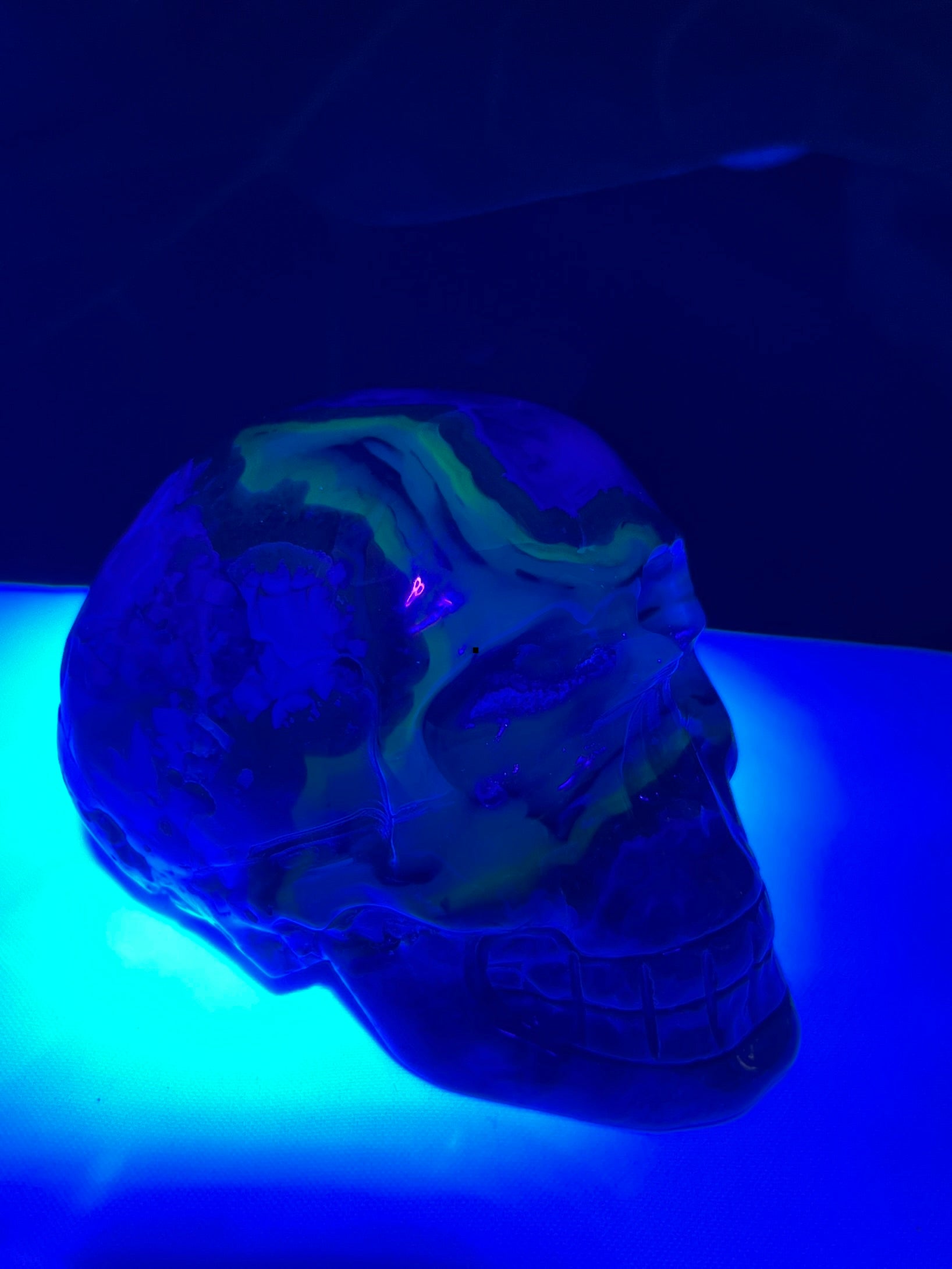
The limitation most buyers do not hear about: not all genuine volcano agate fluoresces. A dark result under UV tells you nothing negative about the stone. Use the test as one signal among several, never as a pass or fail.
Skull Symbolism and the Display Appeal of Carved Stone
Skull carvings carry long-standing symbolic weight across many cultures, often tied to mortality, memory, and ancestral connection. In a collector's cabinet, that symbolism gives the piece a presence that a sphere or tower does not have.
A carved skull is a sculptural object that reads well on a shelf, in a lit cabinet, or on a desk where the polished surface catches light.
If you are building a display, our piece on agate sphere and tower display ideas has layouts that work alongside a skull carving without crowding it.
What Volcano Agate Skulls Cost and What Drives the Price
Pricing for volcano agate skulls depends mainly on size, carving quality, pattern complexity, and whether the stone is natural and untreated. Larger carvings with strong banding and clean polish sit at the top of the range.
At Oak & Quartz, our volcano agate skulls start at $138, and blue plume agate skull carvings start at $28.
| Grade | Typical Size | Pattern & Polish | Price Position |
|---|---|---|---|
| Entry carving | Small, palm-sized | Simple banding, basic polish | Lowest |
| Collector grade | Medium, display-sized | Clear banding, clean polish | Mid to upper |
| Statement specimen | Large, cabinet-sized | Complex pattern, mirror polish | Highest |
How to Clean and Store Agate Skulls Without Damaging Them
Our guide on how to clean delicate crystal jewelry covers the gentle handling techniques that apply here too.
Watch out: never leave a carved agate piece soaking. Prolonged water exposure can work into fractures and dull the polish over time.
Choosing Your Volcano Agate Skull from Oak & Quartz
Choosing a volcano agate skull comes down to three things: the pattern you respond to, the size that fits your space, and confidence that the stone is natural and the carving genuine. Everything else is detail.
Each carving is individually sourced on video call to ensure quality of the artisan work, and every piece is 100% hand-carved and polished in Java, Indonesia, with no dye or enhancement.
If you are ready to look, browse the full volcano agate skulls collection and see the current pieces. For a deeper look at why this stone suits display and decor, read why volcano agate works for crystal home decor.
The hardest part of collecting carved stone is trusting what you are buying. Our team inspects every carving before it is listed, states plainly whether a piece is natural, and photographs each specimen under studio light so you know what is arriving. Browse the current volcano agate skulls, compare the banding across pieces, and add the one that fits your collection.
Frequently Asked Questions
Is volcano agate real or fake?
Oak & Quartz states that its volcano agate skulls are all natural with no dye or enhancement, and each carving is individually sourced on video call to ensure quality of the artisan work.
Do volcano agate skulls glow under UV light?
Some agate does fluoresce under ultraviolet light, and UV reactive volcano agate is a known variant, but not every piece will glow. Test yours with a standard UV torch in a dark room and look for a soft green or yellow response. A lack of glow does not mean the stone is fake, since fluorescence depends on trace minerals rather than authenticity. Treat UV response as a bonus characteristic, not a buying requirement.
How should you clean and store an agate skull?
Dust with a soft dry cloth or a barely damp microfiber cloth, then dry immediately. Avoid acidic cleaners, ultrasonic baths and prolonged soaking, which can dull a polished surface over time. Store the skull on a padded shelf or in a lined box away from direct sunlight, and keep it from knocking against harder stones. Handle it with clean hands, since oils and grit are the main causes of surface wear on carved agate.
Why do collectors collect carved crystal skulls?
A volcano agate skull is a one-of-a-kind object: the banding and color are fixed by the nodule before the carver starts work, so no two are alike. Each carving is individually sourced on video call to ensure quality of the artisan work.
