

Last Updated: November 21, 2026
Quick Summary
Amethyst stalactite cuffs are essential for crystal lovers because each one is carved from a natural stalactite slice, so the concentric growth rings wrap around your wrist and no two pieces match. The adjustable band solves fit, and the amethyst stalactite meaning pairs calm and clarity with slow, grounded growth.
- Each cuff is hand-carved and polished in Java, Indonesia, from a single stalactite slice.
- Quartz ranks 7 on the Mohs scale, so polished slices hold up reasonably well in jewelry.
- Measure your wrist below the bone, add roughly half an inch, then bend the cuff once.
- Repeated bending weakens the metal through work-hardening and can crack the band.
- Oak & Quartz sells its Amethyst Stalactite Adjustable Cuff Bracelets at $65 with 63 reviews.
Table of Contents
- What Makes Amethyst Stalactite Cuffs Different From Other Crystal Jewelry
- The Amethyst Stalactite Meaning Behind Every Banded Slice
- Inside an Amethyst Stalactite Slice: Formation, Banding, and Crystal Faces
- How to Choose Crystals for Intention Without Getting Lost in the Metaphysical Aisle
- Fit, Sizing, and Wearability: Getting a Cuff That Actually Stays On
- Caring for Crystal Jewelry: Cleaning, Storage, and Everyday Durability
- Choosing Your Amethyst Stalactite Cuff at Oak & Quartz
- Frequently Asked Questions
What Makes Amethyst Stalactite Cuffs Different From Other Crystal Jewelry
Most crystal jewelry is cut from a flat slab, tumbled smooth, and set in metal that hides the stone's edges. Amethyst stalactite cuffs work the opposite way.
At Oak & Quartz, our stalactite cuffs are hand-carved and polished in Java, Indonesia. Because each slice is a cross-section of natural growth, no two pieces show identical banding.
Here's what separates amethyst stalactite cuffs from standard crystal bracelets and pendants:
- The stone is the structure. There's no heavy setting or prong work, just the polished slice and an adjustable band.
- The pattern is geological. The banding formed over thousands of years inside a volcanic cavity, and the carving simply reveals it.
- No two pieces match. A slice is a cross-section of a single formation, so the rings, color depth, and crystal faces are one of a kind.
- It's adjustable. A cuff bends to fit, which matters more than most buyers expect before they try one on.
That last point deserves attention. Fit is where most online crystal jewelry purchases go wrong, and a cuff solves it better than a fixed-size bangle ever could. Keep reading, because we'll show you exactly how to size one and what to check before you buy.
The Amethyst Stalactite Meaning Behind Every Banded Slice
Ask ten collectors what amethyst means and you'll get a range of answers. The amethyst stalactite meaning sits at the intersection of two traditions: amethyst's long association with calm and clarity, and the stalactite's reputation as a stone of slow, grounded growth.
Amethyst has carried a reputation for sobriety and clear thinking since ancient Greece, where the name was linked to a myth about a nymph and a god of wine.
Put the two together and the amethyst stalactite meaning becomes something like this: steady progress toward a calmer, clearer mind. Whether you read that literally or symbolically, it's a useful frame for how you wear the piece.
A quick note on honesty here. Crystal healing is a personal practice, not a medical treatment. We sell jewelry we find beautiful and meaningful. We don't claim a cuff will cure anything, and no reputable seller should.
Inside an Amethyst Stalactite Slice: Formation, Banding, and Crystal Faces
Amethyst itself is a purple variety of quartz, and quartz ranks 7 on the Mohs scale, which is why polished slices hold up reasonably well in jewelry. The stalactite form is rarer.
When an artisan cuts across that structure, three features appear:
- Banding. Alternating purple, white, and grey rings, sometimes with agate-like swirls, that trace each growth phase.
- Crystal faces. Small points of quartz, often in the center or along a cavity, that catch light differently from the polished surface.
- Color depth. The richest purple usually sits in the outer bands, while the core runs paler or more crystalline.
Look for crisp, well-defined banding and a visible crystal pocket, not just color saturation.
How to Choose Crystals for Intention Without Getting Lost in the Metaphysical Aisle
The honest answer to how to choose crystals for intention is simpler than the shelves suggest: pick the stone whose meaning matches what you're working on, then pick the piece you'll actually wear.
Use this checklist before you commit:
- Name the intention in one sentence. Calm, clarity, focus, protection, rest.
- Match the stone to that intention. Amethyst for calm and mental clarity, for example.
- Decide how often you'll wear it. Daily wear needs a durable format like a cuff.
- Check the stone's hardness. Quartz is reasonably hard but can chip, so jewelry needs care.
- Confirm the piece is natural and untreated. Ask the seller directly.
- Look at real photos, not just renders. Color and size vary in natural stone.
That last point answers a question we hear often: buyers worry the piece will arrive smaller or paler than the photo. If you're exploring ideas for someone else, our guide to gemstone gifts for crystal lovers covers how to match a stone to a person rather than a mood.
The intention part is personal. The format part is practical. Get both right and you'll wear the piece for years.
Fit, Sizing, and Wearability: Getting a Cuff That Actually Stays On
A cuff that slips off is a cuff you stop wearing.
That half-inch allowance is not arbitrary. A cuff sits on the widest part of the wrist and relies on slight tension to stay oriented.
A few wearability details worth knowing:
- Open-back cuffs should be adjusted once and left alone. Repeated bending weakens the metal over time through work-hardening, and a band that has been flexed dozens of times will eventually crack at the bend point.
- Slice thickness matters. A thicker slice sits higher on the wrist and feels more like a statement piece; a thinner one wears closer to the skin and is less likely to collide with cuffs or watch bands on the same arm.
- Crystal faces catch on fabric. If you wear fine knits, check whether the slice has protruding points before buying. A slice with a recessed crystal pocket wears more smoothly than one with exposed points.
- Wear it on your non-dominant arm for the first week while you get used to the weight and the band tension.
- Check the opening width. A cuff opening that is narrower than your wrist bone will need to be flexed wider before you put it on, which adds stress to the band. Ask the seller for the opening measurement, not just the inner diameter.
What most guides miss is that cuff comfort is about the band's tension, not just the diameter. Too loose and it rotates; too tight and it leaves a mark.
Watch out: bending a cuff back and forth to "test" the fit is the most common way buyers shorten the life of an adjustable band. Shape it once, then leave it alone.
Construction details matter as much as fit.
Here are the fit and wearability facts worth checking before you shape a cuff.
| Item | Value | Note |
|---|---|---|
| Wrist measurement | Just below the wrist bone | Use a soft tape |
| Comfort allowance | Roughly half an inch | Add to wrist measurement |
| Adjustment | Bend once, in small increments | Flex from the open ends |
| Repeated bending | Weakens metal over time | Work-hardening can crack the band |
| First week | Wear on non-dominant arm | Get used to weight and tension |
| Opening width | Ask seller for measurement | Narrower than wrist bone adds stress |
| Band material | Ask if plated or solid | Plated bands wear at flex points |
Caring for Crystal Jewelry: Cleaning, Storage, and Everyday Durability
Crystal jewelry lasts when you treat it like the mineral it is. Quartz is reasonably hard, but it chips, and the polished surface on a stalactite slice can dull with rough handling.
Cleaning: wipe the slice with a soft, damp cloth and dry it immediately. Avoid ultrasonic cleaners, harsh chemicals, and prolonged soaking, all of which can affect the finish or any metal components.
Storage: keep each piece in its own soft pouch or compartment. Crystal against crystal invites scratches, and a slice with exposed crystal faces is especially vulnerable.
Everyday durability: a cuff handles normal daily wear well, but take it off for gym sessions, gardening, and cleaning.
If you want a deeper routine, our guide on how to cleanse and charge crystal jewelry walks through methods that won't damage the stone. And if you're weighing whether a crystal piece suits your daily habits at all, is crystal jewelry durable for daily wear answers that question directly.
Choosing Your Amethyst Stalactite Cuff at Oak & Quartz
If you've read this far, you know what to look for in an amethyst stalactite cuff. The remaining question is which one, and how to tell a good slice from a pretty photograph.
Before you buy anywhere, run this authenticity and value checklist:
- Natural formation. A true stalactite slice shows concentric growth rings that follow the shape of the original drip structure. Rings that are perfectly uniform, or that stop abruptly at a straight edge, suggest a cut-and-assembled piece rather than a single slice.
- Treatments. Ask directly whether the stone is dyed, heat-treated, or stabilized. Amethyst color can be enhanced, and a seller who states "all natural, no dye or enhancement" in writing is giving you something to hold them to.
- Crystal faces. A visible crystal pocket or small quartz points in the center or along a cavity are a sign of an intact formation and usually add collectible value. A slice that is uniformly polished with no crystal structure is still beautiful but less distinctive.
- Workmanship. Check the polish for hazy patches, the band for even thickness, and the mount for gaps where the slice meets the metal. Rough edges around the slice are a sign of rushed finishing.
- Provenance. Origin matters for both authenticity and pattern character. Indonesian stalactite material from Java is known for tight banding and strong purple-to-white contrast, and a seller who can name the source is showing their hand.
- Price context. Natural, hand-carved slices sit above mass-produced dyed stone and below museum-grade specimens. If a price seems far below the market for natural material, ask what is being substituted.
Our Amethyst Stalactite Adjustable Cuff Bracelets are hand-carved and polished in Java, Indonesia. Each carving is individually sourced on video call to ensure quality of the artisan work. All natural: no dye or enhancement. The cuff is adjustable.
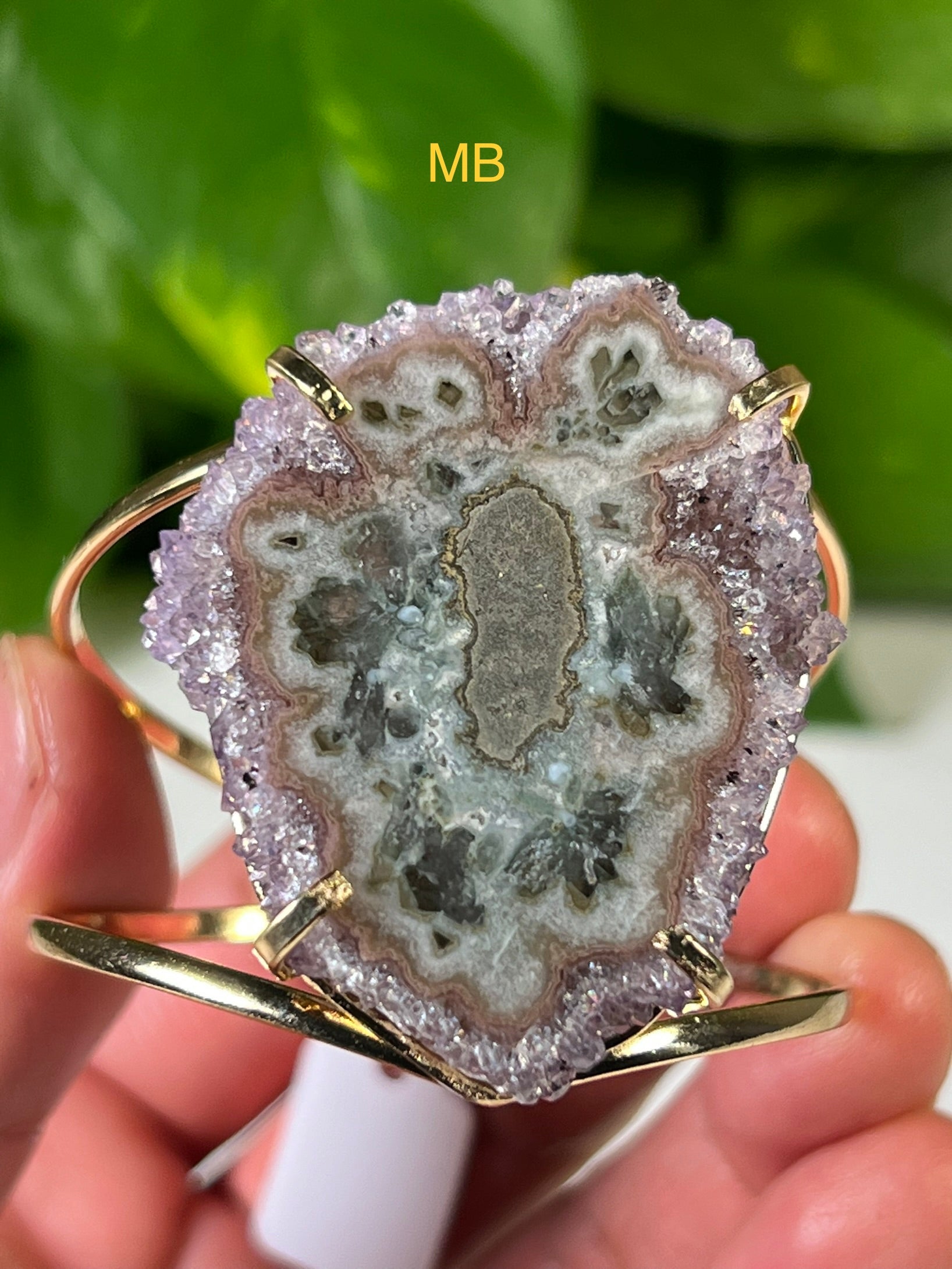
At $65, it is one of our Amethyst Stalactite Adjustable Cuff Bracelets. Each piece is photographed indoors with one studio light.
Our customers have left 63 reviews.
A cuff that fits, a stone you can trace to a real formation, and a piece no one else owns. That's a different purchase from a tumbled bracelet off a rack.
Frequently Asked Questions
How can you tell if an amethyst stalactite cuff is natural?
Look for uneven banding, color that shifts subtly across the slice, and small natural inclusions or crystal faces. Dye tends to sit in cracks and look uniform, while natural amethyst shows depth and variation. Ask whether the piece is untreated, and check that the seller describes the carving process. Oak & Quartz states its stalactite cuffs are all natural with no dye or enhancement, and each carving is sourced on video call to verify artisan quality.
What is the spiritual meaning of amethyst stalactites?
Amethyst stalactite meaning draws on two traditions: amethyst's long association with calm, clarity, and protection, and stalactite's slow formation over thousands of years, which many collectors read as a symbol of patience and inner growth. People often use them for meditation, self-reflection, and setting intentions. Treat these as personal and symbolic rather than medical claims, and choose a piece whose banding and tone you genuinely connect with.
How do you size and adjust an amethyst stalactite cuff?
Cuffs work best when they slide over the narrowest part of your wrist and sit with a small gap. Measure your wrist circumference and note whether the band is open or adjustable. Adjustable cuffs can be gently opened or closed once to fit, but repeated bending stresses the stone. Oak & Quartz's Amethyst Stalactite Adjustable Cuff Bracelets are hand-carved and polished in Java, Indonesia, so fit it once and then leave it alone.
How should you care for an amethyst stalactite cuff?
Keep it dry, store it separately in a soft pouch, and put it on last when getting dressed so perfume and hairspray do not settle on the stone. Clean with a barely damp cloth and dry immediately; skip ultrasonic cleaners and harsh chemicals. Amethyst sits at 7 on the Mohs scale, so it resists scratches but can chip on hard impact. Avoid wearing the cuff during gym sessions, gardening, or washing dishes.
