

Table of Contents
- What an Agate Sphere Can and Cannot Do for Focus
- Choosing an Agate Sphere by Variety, Size and Use
- Where to Place an Agate Sphere in Your Workspace
- A Daily Routine for Using Your Agate Sphere
- Setting Intentions for Clarity and Direction
- Caring for Your Sphere and Spotting Genuine Agate
- Start Your Focus Practice With the Right Sphere
- Frequently Asked Questions
What an Agate Sphere Can and Cannot Do for Focus
Last Updated: November 12, 2026
Many people wonder whether a polished stone can help them concentrate. The honest answer is that a stone like this is at most a physical cue for attention, not a source of magic.
A sphere will not replace sleep, fix a noisy environment, or make an overloaded schedule manageable. Claims that crystals directly rewire the brain or guarantee productivity are not supported by evidence.
Choosing an Agate Sphere by Variety, Size and Use
Not every agate sphere suits every person, so decide what you want from the object before you buy. Variety, size, and planned use all shape the experience.
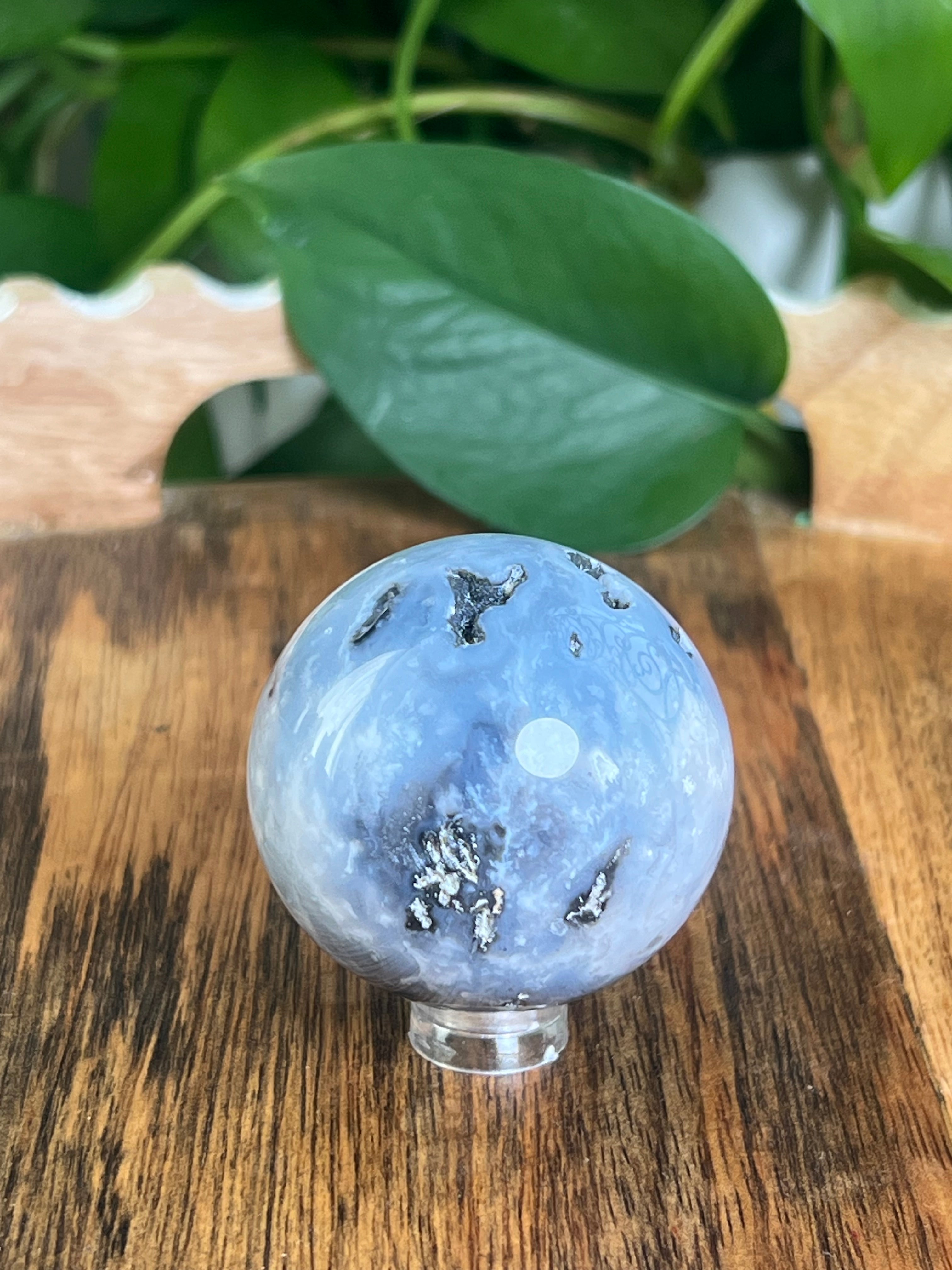
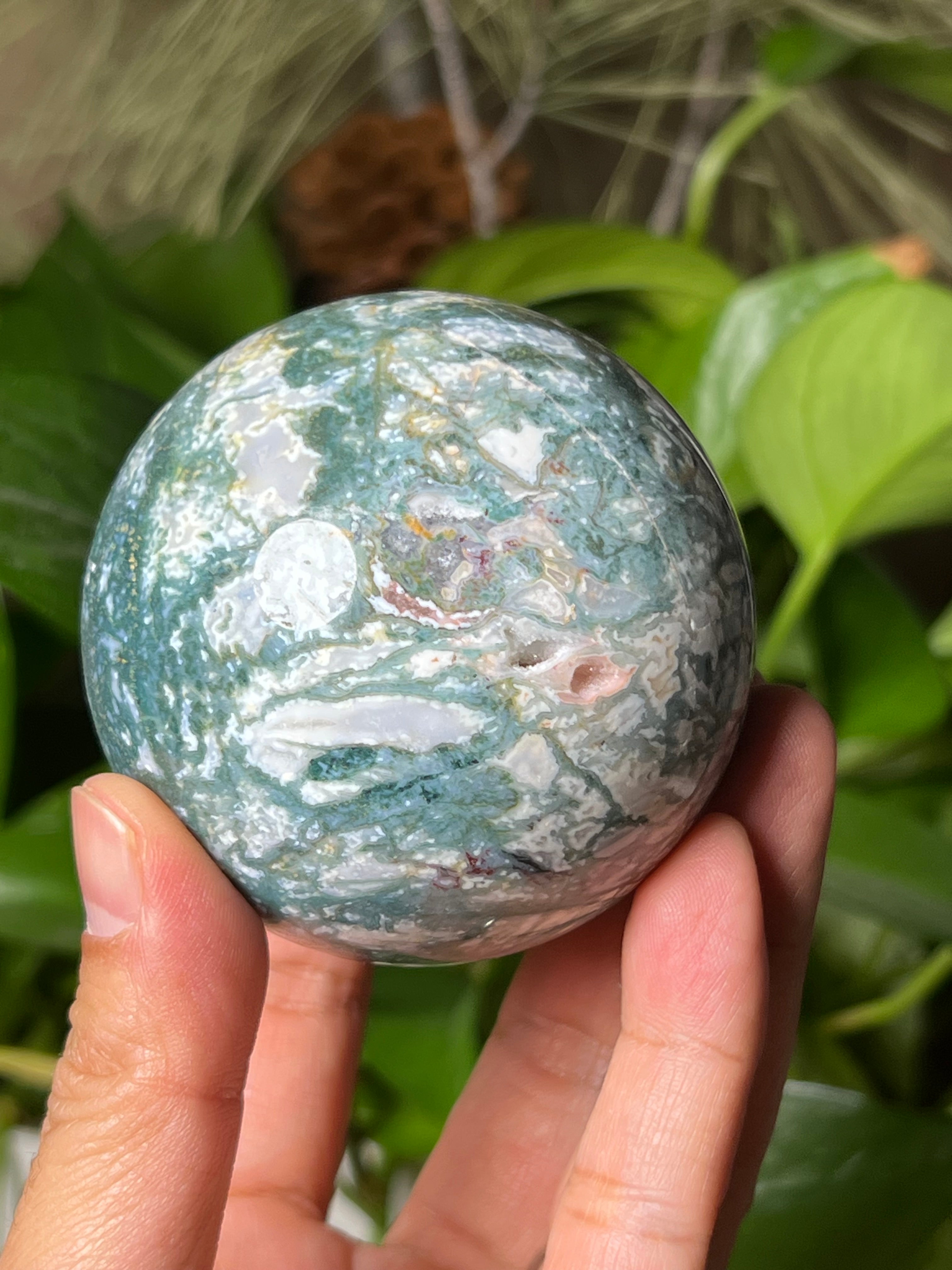
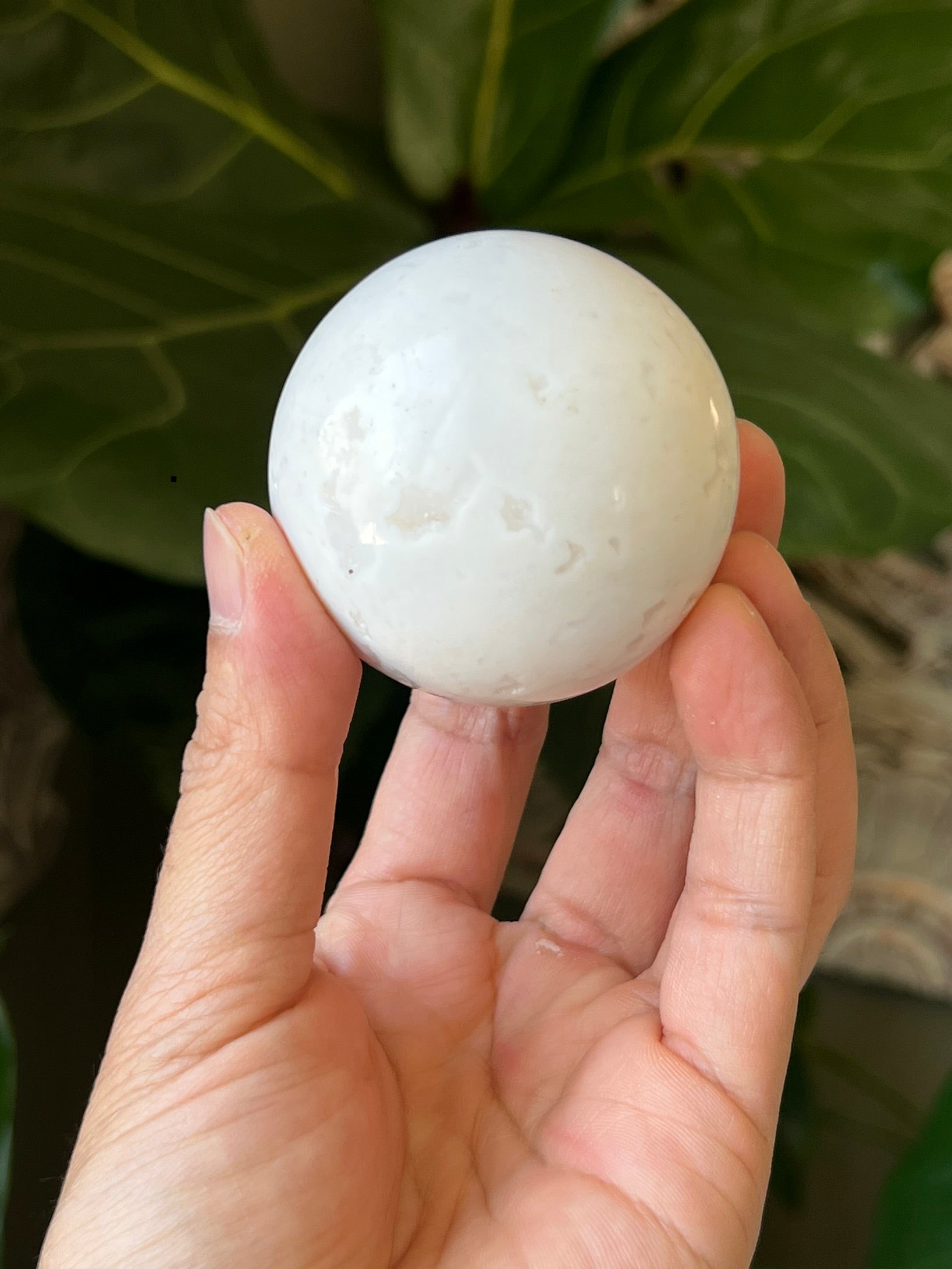
Agate comes in many patterns, and the banding and inclusions you prefer will affect how engaging the sphere feels to look at.
Plume, Moss and Snow Agate Compared
Compare varieties by what you will actually see during a focus session.
- Blue plume agate: Our Blue Plume Agate Sphere: NF is hand-carved and polished in Java, Indonesia, at $30.00.
- Moss agate: Explore our Moss Agate Sphere at $82.00, carved and polished in Canada.
- White plume agate: Our White Plume Agate Sphere is $40.00 and hand-carved in Indonesia.
Pick the one whose pattern you would enjoy looking at for ten quiet minutes. Personal preference matters more than any label.
Matching Sphere Size to Your Hand and Desk
Size affects comfort. A sphere that fits your palm lets you hold it without strain during a short pause, while a larger piece works better as a steady visual object on a shelf or desk.
- Palm-sized: Easiest for hand-held warm-ups and travel
- Desk-sized: Best as a fixed focal point you glance at while working
- Check the weight: Heavier spheres feel more grounding but can be tiring to hold for long
Measure the space where it will live before you commit. A sphere that crowds your keyboard becomes a distraction rather than a help.
Price of Plume, Moss and Snow Agate Spheres
Where to Place an Agate Sphere in Your Workspace
Placement is where most agate-sphere advice stays vague. "Put it somewhere you can see it" is true but not useful when your desk has a monitor, keyboard, phone, mug, and papers competing for the same square foot. The goal is a deliberate visual anchor, not another object in the clutter, so choose a spot by function, not aesthetics alone.
Map Your Desk Before You Move the Sphere
Identify your three zones: the primary work zone (keyboard, mouse, active documents), the secondary zone (reference materials, notebook, lamp), and the rest zone (where your eyes land when you look up). The sphere belongs in the rest zone. If it sits between you and your keyboard, you will move it within a day.
A practical layout that works for most desks:
- Monitor at center, top of the screen roughly at eye level.
- Sphere to the side of the monitor, about 15 to 30 cm from the screen edge, on the side opposite your dominant hand so it does not compete with mouse reach.
- Phone face-down and out of the rest zone, ideally in a drawer or across the room during focus blocks.
Choose the Sightline, Not Just the Spot
Sit in your working posture and look up from the screen without turning your head. Wherever your gaze naturally falls is your rest zone. Put the sphere there. If you have to swivel or lean to see it, it will stop functioning as a cue within a week.
Manage Distraction at the Placement Stage
The sphere only helps if the surrounding area is quieter than the rest of the desk. Two concrete moves:
- Clear a 30 cm radius around the sphere of chargers, cables, sticky notes, and anything you reach for without thinking. Those objects train your eye to flicker; the sphere trains it to rest.
- Face the sphere away from traffic. If your desk sits in a hallway or facing a doorway, angle the sphere so it is not in the same line of sight as people walking past. Movement in the periphery defeats the purpose of a still focal point.
Match Placement to the Type of Work
- Deep writing or coding: sphere in the rest zone, phone out of the room, one tab open. The sphere marks the pause between paragraphs, not the reward for finishing.
- Reading and research: sphere slightly closer, within arm's reach, so you can hold it for a few seconds between sections without standing up.
- Calls and meetings: sphere visible but off to the side; it is a between-meeting reset, not something to fiddle with on camera.
A Quick Placement Check
After a week, ask three questions: Did I actually look at the sphere during work? Did looking at it help me return to the task, or did it become a distraction? Did I move it? If you moved it more than once, the spot was wrong, not the stone.
A Daily Routine for Using Your Agate Sphere
Most guides stop at "hold the sphere and breathe." That is a moment, not a routine. A routine has a start, a middle, an end, and a way to tell whether it is working. The structure below is short enough to repeat on a bad day and specific enough to follow without re-reading this article each morning.
The Three-Part Structure
Every focus block has the same shape:
- Open (about 2 minutes): the sphere as a start signal.
- Middle (the work block): the sphere as a drift reset.
- Close (about 1 minute): the sphere as a stop signal and a one-line note.
The open and close are fixed. The middle is flexible and depends on how often your attention wanders.
Open: The Two-Minute Start Signal
Do this before you open your task list or your inbox.
- Sit down and place the sphere in your open palm, or set it in its rest-zone spot if you are using a desk-sized piece.
- Follow one band or plume line slowly from edge to edge with your eyes. Do not rush to the next line.
- Take three slow breaths while you look.
- Say or write one specific task for the block: not "work on the report" but "draft the intro and the first two subheads."
- Put the sphere back in its spot and start.
Time: about 2 minutes. Frequency: once at the start of each work block, not once a day.
Middle: The Drift Reset
When you notice your attention has left the task, do not scroll, do not check messages, and do not "just quickly" look something up.
- Stop typing or reading.
- Pick up the sphere or rest your eyes on it.
- Take one slow breath and name what pulled you away: a notification, a hard sentence, a boring stretch, a physical need.
- Return to the exact line or sentence you left.
Time: 10 to 20 seconds. Frequency: as often as needed, but aim to notice the drift before you act on it.
The first reset of a block is usually the hardest; later ones get easier.
Close: The One-Line Note
At the end of the block, pick up the sphere, take one breath, and write a single line: what you finished, and what the next block should start with. That line bridges to the next open and removes the blank-page pause.
A Simple Focus Log to Check Whether It Is Working
You do not need an app. A notebook page with five columns is enough:
| Date | Block length | Resets used | Task finished? (Y/N) | One-word note on focus |
Fill it in at the close of each block. After two weeks, look for patterns rather than a single good or bad day:
- Resets trending down across the week usually means the routine is settling in.
- Resets flat or rising with the same task type points to an environmental issue, noise, phone, unclear task, rather than the sphere.
- Tasks finished more often on days you ran the full open-close is the signal that matters most; the log tells you whether the cue is doing its job.
Be honest about what the log can and cannot show. It tracks your own perception of focus and whether you completed what you set out to do. It does not measure brain changes, and no crystal practice should be presented as a substitute for sleep, breaks, or a workable schedule. If focus problems persist despite a steady routine, the useful next step is a conversation with a doctor or a focus coach, not a larger sphere.
Adapting the Routine to Real Days
- Short days: run the open and close only; skip the middle resets if the block is under 25 minutes.
- Meeting-heavy days: use the open before the first deep block and the close after the last one; the sphere is a bookend, not a per-meeting ritual.
- Travel: a palm-sized sphere in a soft pouch keeps the open and close intact; the placement rules do not apply on a train tray table, so treat it as a hand-held practice only.

The routine has three parts, and the same facts repeat in each step, so the table below sums up what to do, how long it takes and how often.
| Stage | What to do | Time or frequency |
|---|---|---|
| Open | Hold sphere, follow one line, three breaths, name one task | About 2 minutes, once per work block |
| Drift reset | Stop, look at sphere, one breath, return to the line | 10 to 20 seconds, as needed |
| Close | Breathe, write one line on what's done and what's next | About 1 minute, end of each block |
| Focus log | Record block length, resets, task finished, one-word note | After each block; review after two weeks |
Setting Intentions for Clarity and Direction
Many people pair the sphere with a written intention. A clear sentence about what you want to finish gives your focus a direction to follow.
Write one specific goal, such as "draft the first two sections of my report" rather than "be productive." Place the sentence beside the sphere so you see both together. When you finish, cross it off and choose the next one.
Caring for Your Sphere and Spotting Genuine Agate
A well-cared-for sphere lasts for years and keeps its shine.
- Clean gently: Wipe with a soft, dry or slightly damp cloth
- Avoid harsh cleaners: Skip solvents, bleach, and abrasive pads
- Store safely: Keep it away from hard surfaces that could chip it
Buy from sellers who describe the origin and treatment of each piece. Our spheres are all natural, with no dye or enhancement, and each carving is individually sourced on video call to ensure quality of the artisan work.
Start Your Focus Practice With the Right Sphere
Begin with one sphere, one spot on your desk, and the two-minute warm-up.
If you are ready to choose, browse oakandquartz's current selection and pick the piece that suits your workspace. Our Blue Plume Agate Sphere is a good place to start.
BUTTON: Shop Agate Spheres CARD_TITLE: Ready to find your focus stone? CARD_TEXT: Browse hand-carved, all-natural agate spheres from oakandquartz.
Frequently Asked Questions
Which crystal is best for focus and concentration?
No crystal has been proven to improve focus, so treat any stone as a tool for a routine rather than a cause of results. Agate is a popular choice for its banded and plume patterns. Many people pair a sphere with a simple habit, such as a two-minute visual warm-up before a work block. Agate spheres from our collection, including Blue Plume and Moss Agate, are a place to start.
Who should not wear agate stone?
Handle your sphere with clean, dry hands and store it on a stable surface. People with health concerns should consult their clinician.
Can an agate sphere help with concentration while studying?
An agate sphere can serve as a consistent cue for concentration rather than a direct cause of it. Place it on your study desk within sight, hold it during a short pre-study breath, and return to it whenever your attention drifts. Keeping the same routine each session can help you build a habit around starting work.
How do you choose an agate sphere for a personal intention?
Start with the pattern you find visually calming, since you will be looking at it during focus sessions. Our plume and moss agate spheres are available in different sizes. Check that the stone is 100% hand-carved and all natural, with no dye or enhancement. Naming a single intention, such as clarity on one project, before you hold the sphere gives the practice a clear and repeatable purpose.
