

Table of Contents
- Why Handcrafted Crystal Necklaces for Women Stand Out
- Raw Crystal Necklace Meaning
- Best Crystals for Daily Wear
- How to Clean Crystal Jewelry
- Ethical Sourcing and Authenticity Verification
- Styling Handcrafted Crystal Necklaces for Different Necklines
- Conclusion
- Frequently Asked Questions
Last Updated: September 15, 2026
Why Handcrafted Crystal Necklaces for Women Stand Out
A handcrafted crystal necklace is assembled by hand, where an artisan selects, shapes, and sets a natural gemstone rather than relying on mass-produced molds. No two stones behave alike, so the maker's judgment shapes everything from the pendant's weight to how the light moves through it. This guide from oakandquartz covers raw crystal meaning, the best stones for daily wear, cleaning, sourcing, and styling.
When a maker wire-wraps a labradorite pendant or sets a druzy cabochon, the setting has to answer to the stone's actual contours. That is why two necklaces from the same bench can differ in silhouette, and why collectors treat artisan-made pieces as individual specimens rather than inventory. Oak & Quartz builds its collection around this principle, featuring rare material such as Iris Agate, Maligano Jasper, and Druzy Pink Crazy Lace, each chosen for pattern and character rather than uniformity.
Raw Crystal Necklace Meaning
A raw crystal necklace features a stone left in or close to its natural form, with minimal cutting, so its meaning leans on the crystal's unaltered character. In crystal communities, raw and lightly polished stones are associated with grounding, authenticity, and unforced energy, while faceted stones are read as amplifying and directing that energy. Neither is better; they suit different intentions.
The rise of raw crystal jewelry tracks a broader shift toward natural, untreated materials in accessories. Search interest in gemstone jewelry continues to climb, and Google Trends data on crystal jewelry searches reflects sustained curiosity rather than a passing spike.
For everyday wear, raw shapes have a practical advantage: their irregular surfaces catch light from more angles, so a pendant stays visually interesting against both dark and light clothing. The trade-off is that raw edges can snag on fine knits, so a smooth bezel setting or slightly domed cabochon often wears better under a scarf or collar.
What does a raw crystal necklace symbolize?
A raw crystal necklace symbolizes connection to a stone's natural, unmodified state. Wearers often choose raw pieces for intention setting, grounding, or self-expression, treating the stone's texture as a reminder of the intention they set when they put it on.
Raw vs. polished: how the finish changes the meaning
Most guides treat raw and polished as a style preference. In practice, the finish changes three things: how the stone reads energetically, how it wears against fabric, and how it photographs.
- Energetic reading. Raw stones are described as holding energy in its "unprocessed" state, good for grounding, patience, and slow work. Polished and faceted stones are described as directing or amplifying energy, good for focus, clarity, and intention work that needs a push. This is a community convention, not a measurable property, but it is the convention most buyers shop inside of.
- Wear behavior. A raw point or cluster has edges that catch on a long chain over silk, but read as texture on a shorter chain over a crew-neck tee. A tumbled or cabochon finish sits flatter and survives daily wear with less snagging.
- Photography and resale. Raw specimens photograph with more shadow and depth, which is why they dominate social feeds. Polished stones photograph cleaner but can look flatter online than in person. If buying from photos, ask for a short video in natural light, the same stone can look like two different pieces under studio lighting.
A concrete example: labradorite
Labradorite is the clearest case study for why finish matters. A raw chunk shows the stone's full schiller, the blue-green flash, across an irregular surface, so the color shifts as you move. A polished cabochon concentrates that flash into a single plane, reading brighter in photos but losing the shifting quality. Neither is wrong: raw feels alive on the body, polished reads clearly across a room.
How to choose between raw and polished
A simple decision rule most stylists and makers use:
- Choose raw if you wear textured fabrics (linen, chunky knits, denim) and want the stone to feel like a found object.
- Choose polished if you wear smooth fabrics (silk, fine merino, buttoned shirts) and want the pendant to sit flat.
- Choose tumbled if you want the raw look without the snag risk, tumbled stones keep an organic silhouette with softened edges.
Best Crystals for Daily Wear
The best crystals for daily wear are durable, moderately hard stones that resist chipping and hold their color: quartz, amethyst, citrine, and labradorite top the list. Softer or heavily included specimens look striking but need gentler handling, making them better suited to occasional wear.
Here is how the common options compare:
| Crystal | Hardness | Wear Notes | Best For |
|---|---|---|---|
| Quartz | High | Resists scratches, holds polish | Everyday pendant |
| Amethyst | Moderate-high | Fades in prolonged sun | Daily wear, indoor |
| Citrine | Moderate-high | Warm tone, low maintenance | Layering |
| Labradorite | Moderate | Avoid hard knocks | Statement pieces |
| Obsidian | Moderate | Chips at thin edges | Bold, dark styling |
A common mistake is buying a delicate, heavily included stone as a first everyday necklace, then retiring it after the first chip. Start with quartz or amethyst, then branch into softer specimens once you know how you actually wear jewelry.
How to Clean Crystal Jewelry
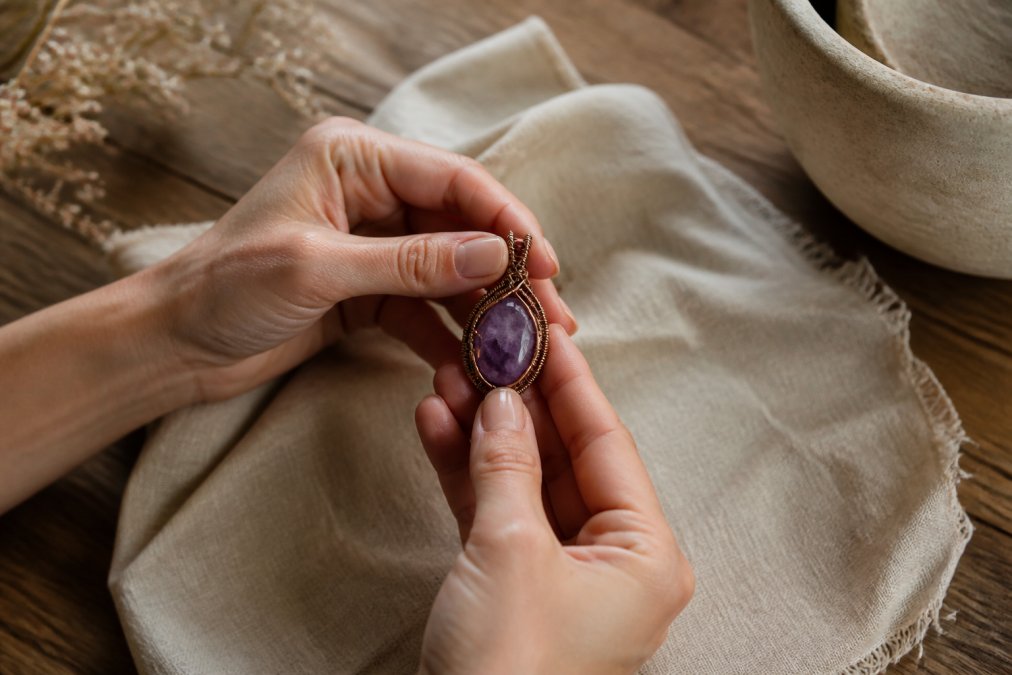
Clean crystal jewelry with lukewarm water, a drop of mild soap, and a soft brush, then pat dry with a lint-free cloth (gia.edu). Skip ultrasonic cleaners and harsh chemicals; they can strip gold-filled layers, loosen settings, and dull a stone's surface. For energy cleansing, many wearers use moonlight, sound, or smoke rather than salt or water, since salt can scratch softer stones and soaking can damage a setting.
- Remove the necklace before showering, swimming, or applying perfume
- Wipe the stone with a dry soft cloth after each wear
- Wash monthly with lukewarm water and one drop of mild soap
- Dry fully before storing; moisture trapped in a setting causes tarnish
- Store separately in a soft pouch to prevent metal-on-stone scratches
For vibrational energy work, intention setting pairs well with a simple routine: hold the piece, state your intention, and let it rest overnight.
Ethical Sourcing and Authenticity Verification
Ethically sourced gemstones come with a traceable chain from mine to setting, and authenticity verification means confirming the stone is natural and untreated rather than dyed, glass, or reconstituted. These are the questions buyers ask most, and they are fair: photos can flatter a stone, and "ethically sourced" is a phrase anyone can print on a label.
Here is a verification checklist you can run before buying anywhere:
- Ask where the material was mined, not just where it was cut
- Request real, unedited photos of the actual piece, not a stock image
- Confirm the stone is natural and untreated, in writing
- Check whether the metal is sterling silver or gold-filled rather than plated
- Look for a stated return policy that lets you inspect the piece in person
- Read reviews for comments on size and color accuracy, not just star ratings
On the sustainability side, mining impact is the part of crystal jewelry that gets discussed least. Small-scale and artisanal mining operations, which supply much of the material used in handcrafted work, are the focus of ongoing reform efforts documented by the OECD's due diligence guidance for responsible mineral supply chains.
Styling Handcrafted Crystal Necklaces for Different Necklines
Pendant shape × neckline: the pairing framework
Chain length is the second variable
Layering rules that actually hold up
A note on skin tone and metal
Conclusion
Frequently Asked Questions
How can you tell if a crystal necklace is handcrafted?
Look for small irregularities in the stone shape, unique wire-wrapped settings, and slight variations in color or inclusions. Handcrafted pieces often have a one-of-a-kind feel because no two stones are identical. Ask about the artist's process and whether the piece is made in small batches. At Oak & Quartz, each necklace is artisan-made, so you'll see natural differences that mass-produced items lack.
What are the benefits of wearing raw crystal jewelry?
Raw crystal jewelry keeps the stone closer to its natural form, which many wearers find enhances its metaphysical properties and vibrational energy. The unpolished surface also gives a more earthy, organic look that pairs well with casual and bohemian styles. For those interested in intention setting or chakra balancing, raw stones are often chosen for their authenticity and connection to natural healing practices.
How do you style handcrafted crystal necklaces for different occasions?
For everyday wear, pair a smaller pendant with a simple chain and casual tops. For evening events, choose a larger statement piece with a V-neck or scoop neckline to draw attention. Layer a raw crystal necklace with a delicate gold-filled chain for a modern look. The key is to let the stone be the focal point and match the necklace length to your neckline.
How should I care for my handcrafted gemstone necklace?
Clean your necklace gently with a soft cloth and lukewarm water, avoiding harsh chemicals or ultrasonic cleaners that can damage softer stones. Store it separately in a pouch to prevent scratches. For energy cleansing, many people use moonlight, sound, or smoke. Avoid wearing your necklace in pools or showers, and check the wire or setting regularly for wear.